Tom Siebel, an early employee of database giant Oracle, later a billionaire after selling his eponymous software firm to Oracle, says his new venture, C3, has a bigger opportunity than either of those.
The amount of the offering is provisional and will likely change in the final deal size.
C3 plans to list under the ticker "AI" on The New York Stock Exchange. The number of shares to be offered and the price range for the proposed offering have not yet been determined, C3 said.
Siebel, who was recruited to database giant Oracle in 1983, later founded the eponymous enterprise customer relationship management software firm in 1993. He sold that company to Oracle in 2006 for $5.85 billion, and went on to found C3 in 2009.
C3 came out of philanthropic work Siebel was doing in 2007 and 2008, after selling to Oracle. He was concerned with making an impact on the planet's energy and climate issues. He soon realized that being a for-profit company might ultimately have a greater impact.
Siebel, who is both chairman and CEO of C3, describes his ambition in the prospectus as being that of serving a $274 billion market that is a "magnitude larger than" either Oracle or Siebel's was.
Siebel refers to a gaggle of technologies, including AI, that have come together to create a new kind of combination he calls a "step function of technologies" that is "substantially more impactful than anything we had seen before."
They include, "elastic cloud computing, big data, the internet of things, and AI or predictive analytics."
Says Siebel,
Today, at the confluence of these technology vectors we find the phenomenon of Enterprise AI and Digital Transformation, mandates that are rising to the top of every CEO's agenda. The global IT market exceeds $2.3 trillion today.
Our singular focus is to leverage our technology leadership, first-mover advantage, and management leadership to establish and maintain a global leadership position in Enterprise AI. Should we succeed at that objective, we will have built C3.ai into one of the world's great software companies.
The company bills itself as the "world's largest enterprise AI production footprint." It claims to be running 1.1 billion predictions per day for its clients, which have included large firms in banking and oil and gas and other industries.
Siebel has brought seasoned compatriots with him. The CTO of C3, Edward Abbo, was CTO of Siebel Systems. The company's head of product, Houman Behzadi, was also a long-time Siebel executive.
The company generated $157 million in revenue in the fiscal year ended in April, it said, an increase of 71%, year over year. It lost $69 million on that revenue. Revenue in the three months ended in July rose 16%, year over year, to $40.5 million.
The company had an accumulated deficit of $293 million as of the end of July.
The prospectus indicates Siebel has heavily invested in the startup, but also sold stock worth tens of millions. In 2018, for example, the company sold stock to Siebel for a loan worth $25 million. Then in 2019, Siebel sold stock in two transactions worth $50 million each.
Tech Earnings
November 14, 2020 at 05:59AM
https://ift.tt/2IqoPFN
C3.ai, machine learning startup backed by software pioneer Tom Siebel, files for IPO - ZDNet
To do this, he used a combination of his own code, and OpenAI's “Generative Pretrained Transformer 2," or GPT-2, a system for generating new text. GPT-2 was rumored to be so powerful—and potentially manipulative—that OpenAI would only tease details about it to the public before releasing the full model. It's since been released along with simpler models, and its developers are even exploring the model's image generation capabilities themselves.
But Rayfield didn't know about the image generation research released in the middle of developing his own project, so he ended up doing the whole thing the long way.
In a video explaining his process, Rayfield said he collected 800 images of pixel-sprites from three different Pokémon games, and wrote a script that would translate each sprite into text, pixel-by-pixel. Each character is assigned a color, with ~ being transparent, and other characters like !, b, a, etc. represent colors.
The result was 100,000 lines worth of sprites. He used that text to re-train GPT-2, which output a random text-based sprite, and then reverse-engineer the line version into a colored-in image. What comes out are garbled little pixel creatures that, if you use your imagination, are pretty close to Pokémon. And let's be honest, even most canonical Pokémon make no natural sense anyway, so the leap isn't far.
Some of the best AI-generated sprites, however, do look close.
"I wouldn't say it looks like a Pokémon, but it looks Pokémon-like," Rayfield said of the results. "If I saw that I'd say there's something going on there, they're trying for something… I'm not sure they did it, but it's certainly not just random pixels. It's got a substance to it, a body there."
Rayfield asked illustrator Rachel Briggs to draw some of the best-looking sprites, and they're believable as something Nintendo might cook up. I'd catch these.
Disclosure: Our goal is to feature products and services that we think you'll find interesting and useful. If you purchase them, Entrepreneur may get a small share of the revenue from the sale from our commerce partners.
Machine learning and artificial intelligence are two of the future's most important technologies. They're used in self-driving cars, financial and health tech, recommendation engines online, and many, many more important industries. But most of us have absolutely no idea how they work. Whether you simply want to gain an understanding of machine learning or you're considering a career change and want to build your skillset, The Machine Learning for Beginners Overview Bundle is a great place to start.
This seven-hour training is led by Idan Gabrieli, an experience solution engineer manager who works with hundreds of companies worldwide to help them address modern business challenges. This bundle is broken down into a simple, three-course track.
In the first course, you'll walk through the fundamental theoretical concepts of machine learning and artificial intelligence. You'll get familiar with the terms used in the industry, understand the difference between Applied and Generalized AI, learn the process of training a model, and much more. The course is geared towards complete beginners so even if you don't know anything about machine learning, you'll be in a good place.
In the second class, you'll begin to explore the theoretical side of machine learning and the practical side of data science. You'll study Python fundamentals and the Pandas data science library, learning how machine learning and artificial intelligence simplify the way we use data. To round it out, you'll perform data analysis and exploration as well as develop complete data science projects.
In the final course, you'll perform Exploratory Data Analysis (EDA) by visualizing a dataset using a variety of chats. You'll explore the fundamentals of data visualization using Matplotlib and Seaborn, understanding how to adjust charts and more. You'll delve into bar, pie, and line charts; create histograms, scatter, heat-map, and hexbin-map charts; and much, much more.
Get a theoretical and practical machine learning and artificial intelligence education with these 108 novice-friendly lessons. Valued at $600, the well-rated Machine Learning for Beginners Overview Bundle is just $19.99 for a limited time.
November 13, 2020 at 08:15PM
https://ift.tt/3kvxVhd
Develop a Basic Understanding of Machine Learning With These Courses - Entrepreneur
The need to pursue racial justice is more urgent than ever, especially in the technology industry. The far-reaching scope and power of machine learning (ML) and artificial intelligence (AI) means that any gender and racial bias at the source is multiplied to the nth power in businesses and out in the world. The impact those technology biases have on society as a whole can’t be underestimated.
“A lot has been happening in 2020, from working remotely to the Black Lives Matter movement, and that has made everybody realize that diversity, equity, and inclusion is much more important than ever,” says Huma Abidi, senior director of AI software products and engineering at Intel – and one of the speakers at Evolve. “Organizations are engaging in discussions around flexible working, social justice, equity, privilege, and the importance of DEI.”
Abidi, in the workforce for over two decades, has long grappled with the issue of gender diversity, and was often the only woman in the room at meetings. Even though the lack of women in tech remains an issue, companies have made an effort to address gender parity and have made some progress there.
In 2015, Intel allocated $300 million toward an initiative to increase diversity and inclusion in their ranks, from hiring to onboarding to retention. The company’s 2020 goal is to increase the number of women in technical roles to 40% by 2030 and to double the number of women and underrepresented minorities in senior leadership.
“Diversity is not only the right thing to do, but it’s also better for business,” Abidi says. “Studies from researchers, including McKinsey, have shown data that makes it increasingly clear that companies with more diverse workforces perform better financially.”
The proliferation of cases in which alarming bias is showing up in AI products and solutions has also made it clear that DEI is a broader and more immediate issue than had previously been assumed.
“AI is pervasive in our daily lives, being used for everything from recruiting decisions to credit decisions, health care risk predictions to policing, and even judicial sentencing,” says Abidi. “If the data or the algorithms used in these cases have underlying biases, then the results could be disastrous, especially for those who are at the receiving end of the decision.”
We’re hearing about cases more and more often, beyond the famous Apple credit check fiasco, and the fact that facial recognition still struggles with dark skin. There’s Amazon’s secret recruiting tool that avoided hiring qualified women because of the data set that was used to train the model. It showed that men were more qualified, because historically that’s been the case for that company.
“Despite great intentions to build technology that works for all and serves all, if the group that’s responsible for creating the technology itself is homogenous, then it will likely only work for that particular specific group,” Abidi says. “Companies need to understand, that if your AI solution is not implemented in a responsible, ethical manner, then the results can cause, at best, embarrassment, but it could also lead to potentially having legal consequences, if you’re not doing it the right way.”
This can be addressed with regulation, and the inclusion of AI ethics principles in research and development, around responsible AI, fairness, accountability, transparency, and explainability, she says.
“DEI is well established — it makes business sense and it’s the right thing to do,” she says. “But if you don’t have it as a core value in your organization, that’s a huge problem. That needs to be addressed.”
And then, especially when it comes to AI, companies have to think about who their target population is, and whether the data is representative of the target population. The people who first notice biases are the users from the specific minority community that the algorithm is ignoring or targeting — therefore, maintaining a diverse AI team can help mitigate unwanted AI biases.
And then, she says, companies need to ask if they have the right interdisciplinary team, including personnel such as AI ethicists, including ethics and compliance, law, policy, and corporate responsibility. Finally, you have to have a measurable, actionable de-biasing strategy that contains a portfolio of technical, operational, organizational actions to establish a workplace where these metrics and processes are transparent.
“Add DEI to your core mission statement, and make it measurable and actionable — is your solution in line with the mission of ethics and DEI?” she says. “Because AI has the power to change the world, the potential to bring enormous benefit, to uplift humanity if done correctly. Having DEI is one of the key components to make it happen.”
The 90-minute Evolve event is divided into two distinct sessions on December 8th:
The Why, How & What of DE&I in AI
From ‘Say’ to ‘Do’: Unpacking real-world case studies & how to overcome real-world issues of achieving DE&I in AI
AI researchers from Virginia Tech and Western University have concluded that an unequal distribution of compute power in academia is furthering inequality in the era of deep learning. They also point to the impact on academia of people leaving prestigious universities for high-paying industry jobs.
The concentration of compute power at elite universities crowds out mid- to low-tier research organizations, according to analysis that draws on 171,394 papers from nearly 60 prestigious computer science conferences. The team reviewed papers accepted for publication at large AI conferences such as ACL, ICML, and NeurIPS in categories like computer vision, data mining, machine learning, and NLP.
“Exploiting the sudden rise of deep learning due to an unanticipated usage of GPUs since 2012, we find that AI is increasingly being shaped by a few actors, and these actors are mostly affiliated with either large technology firms or elite universities,” their paper reads. “To truly ‘democratize’ AI, a concerted effort by policymakers, academic institutions, and firm-level actors is needed to tackle the compute divide.”
Nur Ahmed and Muntasir Wahed summarized their findings and recommendations in a paper titled “The De-democratization of AI: Deep Learning and the Compute Divide in Artificial Intelligence Research.” The paper was published recently on arXiv and presented in late October at Strategic Management Society, a business research conference.
The fact that wealthier universities and companies have an advantage in deep learning is not surprising. Large modern networks like AlphaGo Zero and GPT-3 can require millions of dollars in compute for training. And a December 2019 analysis labeled Google, Stanford University, MIT, Carnegie Mellon University, UC Berkeley, and Microsoft as the top six contributors at leading AI research conferences.
At the same time, smaller schools often lack the financial resources to consider deep learning applications. This limitation can define the kinds of AI that researchers in academia explore or accelerate brain drain to Big Tech companies with plenty of money to compete for top AI talent.
Confirming this opportunity gap, the paper found that universities ranked 301-500 by U.S. News and World Report have published on average six fewer papers at AI research conferences — or 25% fewer than a counterfactual estimator — since the rise of deep learning. Fortune 500 companies, Big Tech leaders, and elite universities saw dramatically different trends.
“To the best of our knowledge, this is the first study that finds evidence that an increased need for specialized equipment can result in ‘haves and have-nots’ in a scientific field,” the paper reads. “We contend that the rise of deep learning increases the importance of compute and data drastically, which, in turn, heightens the barriers of entry by increasing the costs of knowledge production.”
The coauthors say their work demonstrates what they call the “compute divide” along a series of social fault lines. Elite universities tend to have more wealthy students and are typically less diverse than other schools. Big Tech firms also lack diversity, particularly among engineers, people who design products, and AI research. Since AI has become a general purpose technology impacting aspects of business, public services, and private lives, this demographic imbalance has widespread consequences.
In analyzing this trend, Ahmed and Wahed divide the history of artificial intelligence into two eras. They define the first as stretching from the 1960s to about 2012, when general purpose hardware was used to train AI. In the second era, deep learning and specialized hardware like GPUs have defined the industry, since the two were found to be effective together in the ImageNet image classification competition to advance computer vision.
When it comes to solutions, the coauthors say their findings present “concrete evidence” of the need for a national AI research cloud. In June, major universities, tech companies, and members of the U.S. Senate backed the idea of a national AI research cloud. Shared public datasets that can help train and test AI models will be particularly beneficial for resource-constrained organizations.
The paper asserts that the U.S. government should help universities by extending shared public datasets and other resources. Groups like the Defense Innovation Board and National Security Commission on AI (NSCAI) have advised the Pentagon and Congress to increase public-private partnerships, government funding, and outreach to developers working remotely as a way to attract talent from nontraditional backgrounds.
We could see movement on these fronts in the months ahead. President-elect Joe Biden’s platform has committed to investing $300 billion in research and development in areas like 5G and artificial intelligence.
Ahmed and Wahed’s findings are backed up by other recent papers evaluating the AI ecosystem and the technology’s role in bringing academia and industry closer together. For example, a paper called “Artificial Intelligence, Human Capital, and Innovation” found that AI created an unprecedented brain drain from academia between 2004 and 2018, leading to more than 200 people leaving for industry positions. Published in fall 2019 and updated last month, the paper finds that top universities, Ph.D. students, and startups in deep learning are among those that benefit most from current AI talent shortages. The analysis also found that Carnegie Mellon University, MIT, and Stanford University rank highest among colleges whose alumni go on to launch AI startups.
Ahmed and Wahed’s paper also follows a survey of more than 200 computer science department chairs on the impact of industry on academia. Commissioned by the Computing Research Association (CRA) and released a few months ago, the study identifies both positive and negative results of close cooperation between academia and industry. These changes include a shift of computing research faculty to industry jobs.
“This shift has the potential for negative impacts on the kinds of research done, the quality of the research, the culture of computer science departments, and the training of undergraduates and graduate students. Particular attention needs to be focused on issues related to department culture, potential conflict of interest, intellectual property, and ensuring that students continue to have sufficient faculty mentoring and contact to prepare them for their career,” a white paper about the survey reads.
How startups are scaling communication: The pandemic is making startups take a close look at ramping up their communication solutions. Learn how
November 11, 2020 at 11:25PM
https://ift.tt/2IsW5fq
AI research finds a ‘compute divide’ concentrates power and accelerates inequality in the era of deep learning - VentureBeat
Pope Francis has asked believers around the world to pray that robots and artificial intelligence “always serve mankind.”
The message is one of the pope’s monthly prayer intentions — regular missives shared on YouTube that are intended to help Catholics “deepen their daily prayer” by focusing on particular topics or events. In August, the pope urged prayer for “the maritime world”; in April, the topic was “freedom for addiction.” Now, in November, it’s AI and robots.
Although the message sounds similar to warnings issued by tech notables like Elon Musk (the Tesla CEO famously compared work on artificial intelligence to “summoning the demon”), the pope’s focus is more prosaic. He doesn’t seem to be worrying about the sort of exotic doomsday scenario where a superintelligent AI turns the world into paperclips, but more about how the tech could exacerbate existing inequalities here and now.
(We should note also that the call to prayer came out earlier this month, but we only saw it recently via the Import AI newsletter because of the... events that have taken up so much of everyone’s time, energy, and general mental acuity in recent weeks.)
In his message, the pope said AI was “at the heart of the epochal change we are experiencing” and that robotics had the power to change the world for the better. But this would only be the case if these forces are harnessed correctly, he said. “Indeed, if technological progress increases inequalities, it is not true progress. Future advances should be orientated towards respecting the dignity of the person.”
Perhaps surprisingly, this isn’t new territory for the pope. Earlier this year, the Vatican, along with Microsoft and IBM, endorsed the “Rome Call for AI Ethics” — a policy document containing six general principles that guide the deployment of artificial intelligence. These include transparency, inclusion, impartiality, and reliability, all sensible attributes when it comes to deploying algorithms.
Although the pope didn’t touch on any particular examples in his video, it’s easy to think of ways that AI is entrenching or increasing divisions in society. Examples include biased facial recognition systems that lead to false arrests and algorithmically allotted exam results that replicate existing inequalities between students. In other words: regardless of whether you think prayer is the appropriate course of action, the pope certainly has a point.
November 11, 2020 at 09:28PM
https://ift.tt/3eOGdQf
Pope Francis urges followers to pray that AI and robots ‘always serve mankind’ - The Verge
As the world population grows and climate change intensifies, how can we transform the food supply chain to be more sustainable and resilient? Mike Zelkind, co-founder and CEO of 80 Acres Farms, is building a network of hyper-efficient, high-tech, indoor farms to provide local communities with fresh, nutritious produce. He joins Azeem Azhar to discuss the challenges of disrupting the farming industry to innovate the future of food.
They also discuss:
Why fruits and vegetables are now bred for logistics, not for flavor and nutrition.
How robotics and AI are being used to optimize yield, taste, and growing time.
Why “stressing” plants is key to making them healthy.
HBR Presents is a network of podcasts curated by HBR editors, bringing you the best business ideas from the leading minds in management. The views and opinions expressed are solely those of the authors and do not necessarily reflect the official policy or position of Harvard Business Review or its affiliates.
November 11, 2020 at 09:50PM
https://ift.tt/3koVp7C
How AI and Genomics Are Reshaping Farming - Harvard Business Review
This article was translated from our Spanish edition using AI technologies. Errors may exist due to this process.
Artificial intelligence is revolutionizing various industries, markets, and services. However, the creative industries and the art world have not yet been able to use the full potential of this technology. However, two Chilean entrepreneurs devised a platform to go further.
Using the latest technology, they allow creators, amateur filmmakers, visual artists, even the film and music industry to use artificial intelligence algorithms in their work. This is Runway , a platform that integrates machine learning and artificial intelligence to the world of art and creativity.
Founded at the end of 2018 by Cristóbal Valenzuela, Alejandro Matamala and Anastasis Germanidis, Runway started as a thesis project that they developed at New York University (NYU) - where they met - while developing a postgraduate degree.
Its creators define the platform as part of the new generation of creative tools. If Photoshop and Adobe revolutionized the creative market a few decades ago, Runway is looking to do so for years to come.
In this case, the bet of this startup is that with their software in the cloud, they can develop "synthetic content", that is, automatically generate, modify, and edit audiovisual content with artificial intelligence algorithms.
Cristobal, Alejandro and Anastasis, founders of Runway. Courtesy photo
The creation of content within the reach of technology
"We continue to create audiovisual content in the same way that we have done for decades and that makes the process unnecessarily slow, expensive and difficult. With AI algorithms anyone can create hyper-realistic animations in seconds and edit them automatically. Something that only Hollywood or large production companies and special effects have been able to do so far, "explains Valenzuela.
At the same time, Runway makes it possible to shorten development times, in addition to democratizing access to this technology for as many creators as possible. “These technologies are radically changing the way we create content because algorithms are already capable of generating images, text, video and sound in an ultra-realistic way”, explains Cristóbal; to which Alejandro adds "if we put these tools in the hands of people who have never accessed them before, they will start to think of new ways of producing art, generating content and telling stories".
Attention of the industry and investors
The impact of the platform started from when they launched a tweet asking how many would use a tool like the one they had in mind. In less than 48 hours, they already had responses from engineers from Facebook, Google, universities and even the media, indicating that they found the possibility of a creative tool to occupy artificial intelligence algorithms incredible. Immediately after this, they created the company and have not looked back.
The path they have already traveled has been fast. As a result of their work, they have already generated interest from different investment funds. In the same year that they created Runway, they completed a $ 2 million investment round with US funds specialized in technology research startups: Lux Capital, Amplify Partners Compound Ventures.
But also, on a practical level, they have already carried out important projects, such as a collaboration with New Balance for the design of a shoe; be the software with which the rock band YACHT created part of the audiovisual content of their latest album - being nominated for a Grammy Award; be working on the creation of short films generated by IA, and even already collaborating with visual artists and the seventh art.
Along with this, the response of cloud software has also come from the academic world, which has led them to close alliances with various universities in the United States, such as NYU, MIT and UCLA; while in Chile the software is already being used at the Universidad Adolfo Ibáñez, Universidad de las Américas, and the Pontificia Universidad Católica.
At the moment, each step that Runway takes is a path towards the future and that is precisely the bet that its founders are making, by developing residencies or internships in the company for artists and researchers, so that they can deepen the uses and applications of the technology they develop. This was a practice that they had implemented before the outbreak of the coronavirus pandemic and that they will resume in a few more weeks, from their offices located in Brooklyn in New York City.
November 10, 2020 at 11:30PM
https://ift.tt/3nbSX6d
Machine learning and Artificial Intelligence to revolutionize the world of art and creativity - Entrepreneur
LinkedIn today open-sourced Dagli, a machine learning library for Java (and other JVM languages) that ostensibly makes it easier to write bug-resistant, readable, modifiable, maintainable, and deployable model pipelines without incurring technical debt.
While machine learning maturity in the enterprise is generally increasing, the majority of companies (50%) spend between 8 and 90 days deploying a single machine learning model (with 18% taking longer than 90 days), a 2019 survey from Algorithmia found. Most peg the blame on failure to scale, followed by model reproducibility challenges, a lack of executive buy-in, and poor tooling.
With Dagli, the model pipeline is defined as a directed acyclic graph, a graph consisting of vertices and edges with each edge directed from one vertex to another for training and inference. The Dagli environment provides pipeline definitions, static typing, near-ubiquitous immutability, and other features preventing the large majority of potential logic errors.
“Models are typically part of an integrated pipeline … and constructing, training, and deploying these pipelines to production remains more cumbersome than it should be,” LinkedIn natural language processing research scientist Jeff Pasternack wrote in a blog post. “Duplicated or extraneous work is often required to accommodate both training and inference, engendering brittle ‘glue’ code that complicates future evolution and maintenance of the model.”
Dagli works on servers, Hadoop, command-line interfaces, IDEs, and other typical JVM contexts. Plenty of pipeline components are ready to use right out of the box, including neural networks, logistic regression, gradient boosted decision trees, FastText, cross-validation, cross-training, feature selection, data readers, evaluation, and feature transformations.
For experienced data scientists, Dagli offers a path to performant, production-ready AI models maintainable and extensible in the long term that can leverage an existing JVM technology stack. For software engineers with less experience, Dagli provides an API that can be used with a JVM language and tooling that’s designed to avoid typical logic bugs.
“With Dagli, we hope to make efficient, production-ready models easier to write, revise, and deploy, avoiding the technical debt and long-term maintenance challenges that so often accompany them,” Pasternack continued. “Dagli takes full advantage of modern, highly multicore processors and … powerful graphics cards for effective single-machine training of real-world models.”
The release of Dagli comes after LinkedIn made available the LinkedIn Fairness Toolkit (LiFT), an open source software library designed to enable the measurement of fairness in AI and machine learning workflows. Prior to LiFT, LinkedIn debuted DeText, an open source framework for natural language process-related ranking, classification, and language generation tasks that leverages semantic matching, using deep neural networks to understand member intents in search and recommender systems.
How startups are scaling communication: The pandemic is making startups take a close look at ramping up their communication solutions. Learn how
November 11, 2020
https://ift.tt/35lKBTM
LinkedIn open-sources Dagli, a machine learning library for Java - VentureBeat
The year is coming to a close and it’s safe to say Elon Musk’s prediction that his company would field one million “robotaxis” by the end of 2020 isn’t going to come true. In fact, so far, Tesla’s managed to produce exactly zero self-driving vehicles. And we can probably call off the singularity too. GPT-3 has been impressive, but the closer machines get to aping human language the easier it is to see just how far away from us they really are.
So where does that leave us, ultimately, when it comes to the future of AI? That depends on your outlook. Media hype and big tech’s advertising machine has set us up for heartbreak when we compare the reality in 2020 to our 2016-era dreams of fully autonomous flying cars and hyper-personalized digital assistants capable of managing the workload of our lives.
But, if you’re gauging the future of AI from a strictly financial, marketplace point of view, there’s an entirely different outlook to consider. American rock band Timbuk 3 put it best when they sang “the future’s so bright, I gotta wear shades.”
Artificial intelligence has been a world-beater for the past five years when it comes to market growth and that’s unlikely to change anytime soon. The simple explanation for this is that VCs and public investors don’t necessarily care about the big newsworthy AI technologies as much as they do the ones they can profit from. And there are a lot of profits to be made in the overall AI market over the next few years according to most market analysis reports.
B2B technologies, such as call center AI, are steadily rising. According to a market report from Research and Markets:
In 2018, the global call center artificial intelligence (AI) market reached a value of $914.5 million and is expected to generate $2,990.1 million in 2024, witnessing a 22.6% CAGR during the forecast period (2019-2024).
We’re seeing similar growth in relevant, related industries across the machine learning spectrum when it comes to narrow-case B2B technologies. Here’s a quote from a Market Watch report on image recognition technology:
Global AI image recognition market will reach $8,898.2 million by 2026, growing by 26.9% annually over 2020-2026 owing to the rising need for AI-enabled image recognition technology amid the COVID-19 pandemic.
And, as far as the global market size for all AI technologies is concerned, Allied Market Research makes the following prediction:
The global artificial intelligence market size is expected to reach $169,411.8 million in 2025, from $4,065.0 million in 2016 growing.
That’s a massive gain in such a short period, when compared to similar tech markets, and a healthy indication that the AI gravy train is still steaming along the tracks nicely – for those savvy enough to invest in the tried-and-true B2B AI technologies, that is.
As always the biggest players in the AI market – Apple, Amazon, Facebook, Google, and Microsoft – are major driving factors for such lofty market predictions, but they also remain solid bets for AI investment purposes according to market trends going as far back as 2016.
Quick take: Get your investment advice from professionals you trust, not technology journalists. That being said, everything we can find in the end of 2020 market predictions for next year points to a predictable, universal uptick in AI adoption.
As the pandemic forces businesses to invest in AI data technologies to understand an unprecedented consumer marketplace, it’s also reinventing the employee-based technology paradigm through the necessitation of AI-powered remote-working software.
We may yet be years or even decades away from truly autonomous vehicles (no matter what Musk tries to tell you), but the market can’t get enough bedrock AI technology. That’s unlikely to change in 2021 or the foreseeable future beyond next year.
Published November 9, 2020 — 21:16 UTC
November 10, 2020 at 04:16AM
https://ift.tt/3eKaqzZ
Neural’s market outlook for artificial intelligence in 2021 and beyond - The Next Web
Object, person, and pet recognition is one of Google Photos’ best features. Google is now inviting Android users to help improve the service’s machine learning technology through a built-in crowdsourcing tool.
There is a new “Help improve Google Photos” button at the very bottom of the “Search” tab after the various query filters. Featuring the Crowdsource logo, this feature is powered by Google’s micro-task service.
Google wants to better understand “what’s important to you” in pictures. The “Understanding your photos” screen presents pictures from your library with the date noted in the top-right corner. You’re asked to “type in what’s important,” with the option to skip and a progress bar below.
After that initial session, you can improve the following aspects of Google Photos:
Understanding your photos: We’d like to learn what’s important to you.
Printing preferences: Help us understand what you’d like to print
Made for you: Help us create better collages, animations, and more
Holiday photos: Help us learn which photos show a certain holiday or event.
A Google Help document explains how it “may take time to see your contributions impact your account, but your input will help improve existing features and build new ones, like improved suggestions on which photos to print or higher quality creations that you would like.”
This feature is “only available on Android devices,” while you can delete answers that you’ve contributed at any time from the overflow menu on the main screen.
It’s widely rolling out with Google Photos 5.18 today after on-and-off testing over the past year.
More about Google Photos:
Thanks Bruce
FTC: We use income earning auto affiliate links.More.
The Commonwealth Scientific and Industrial Research Organisation (CSIRO) has announced partnerships with Microsoft, Hobart City Council, and Chemistry Australia to address -- and attempt to end -- Australia's plastics waste issue.
Under its plastics mission, CSIRO will work with its partners to develop new solutions that use artificial intelligence (AI), machine learning (ML), and camera sensors for plastics detection and waste monitoring in waterways.
CSIRO senior principal research scientist Denise Hardesty said the goal would be to apply technology to the entire plastics supply chain to eliminate rubbish ending up in the environment.
"Our research is helping to understand the extent of plastic pollution in Australia and globally, and how to reduce it," she said.
"Rethinking plastic packaging is just one way of reducing waste, through better design, materials, and logistics. We can also transform the way we use, manufacture, and recycle plastics by creating new products and more value for plastics."
Specifically, the national science agency is working with Microsoft to use ML and apply camera sensor technologies to waste traps, which are commonly used by councils to prevent rubbish flowing into storm drains, to collect data that can help detect and classify rubbish found in waterways.
"Microsoft AI image recognition is underpinning the identification of plastic pollution," Microsoft Australia CTO Lee Hickin said.
"By using AI to accelerate the detection and classification of rubbish in our waterways, we can simply react more quickly and work to improve the quality of water faster than if done manually."
At the same time, CSIRO is working with Hobart City Council to develop an autonomous sensor network to provide real-time reporting on the amount of rubbish being captured in storm drains.
"By tapping into CSIRO's modelling capabilities, we can optimise our operations to avoid the release of pollutants, while improving safety and reducing environmental harm," City of Hobart Lord Mayor Anna Reynolds said.
Work will also be undertaken with Chemistry Australia to help Australians understand how to sustainably use, re-use, and recycle plastic products, CSIRO said.
The plastics mission is one of 12 missions CSIRO has developed under its plan, known as Team Australia, that is aimed at solving some of the country's challenges using science and technology so it can emerge from COVID-19 in a resilient way.
CSIRO said it would commit at least AU$100 million annually to the co-creation of missions under the plan.
"Each mission represents a major scientific research program aimed at making significant breakthroughs, not unlike solving Prickly Pear, curing the rabbit plague, inventing the first flu treatment, or creating fast Wi-Fi," CSIRO chief executive Dr Larry Marshall said previously.
"But let me stress, these are not just CSIRO's missions.
"Their size and scale require us to collaborate widely across the innovation system, to boldly take on challenges that are far bigger than any single institution."
Dr Cathy Foley named as Australia's next chief scientist
Prime Minister Scott Morrison has announced the appointment of Dr Cathy Foley as Australia's next chief scientist.
Foley will end her tenure as the CSIRO's chief scientist when she takes on her new role in December.
"As we recover from COVID-19 and look to rebuild a brighter future, the role of the chief scientist has never been more important," Morrison said.
"Dr Foley has a big task ahead to drive collaboration between industry and the science and research community, as we look to create jobs for the COVID-19 recovery and for the future."
Dr Foley is a fellow of both the Australian Academy of Science, and the Australian Academy of Technology and Engineering, and has made significant contributions in the area of physics relating to superconductors.
Her appointment as Australia's chief scientist will be for three years and starts in January 2021. Foley will take over from current chief scientist Dr Alan Finkel.
"I would like to thank Dr Alan Finkel AO for his outstanding contribution as chief scientist over the past five years. He has been a valued and respected voice to government, and I know he will continue to make a significant contribution to the Australian and international science communities," the prime minister said.
Appearing during Senate Estimates last month, Finkel said he was preparing a report for National Cabinet into the systems for supporting contact tracing and outbreak management across all states and territories.
He also said there was still a long way to go before the country would reach parity of female and male participation in science, technology, engineering, and mathematics (STEM).
Related Coverage
November 09, 2020 at 07:16AM
https://ift.tt/3l8BNWC
CSIRO to use artificial intelligence, machine learning, and sensors to end plastic waste - ZDNet
doro.indah.link The story of Ted Chiang’s life includes stints as a technical writer in the Seattle area and worldwide acclaim as a science-fiction writer. (Alan Berner Photo via Knopf Doubleday Publicity)
What rights does a robot have? If our machines become intelligent in the science-fiction way, that’s likely to become a complicated question — and the humans who nurture those robots just might take their side.
Ted Chiang, a science-fiction author of growing renown with long-lasting connections to Seattle’s tech community, doesn’t back away from such questions. They spark the thought experiments that generate award-winning novellas like “The Lifecycle of Software Objects,” and inspire Hollywood movies like “Arrival.”
Can science fiction have an impact in the real world, even at times when the world seems as if it’s in the midst of a slow-moving disaster movie?
Absolutely, Chiang says.
“Art is one way to make sense of a world which, on its own, does not make sense,” he says in the latest episode of the Fiction Science podcast, which focuses on the intersection between science and fiction. “Art can impose a kind of order onto things. … It doesn’t offer a cure-all, because I don’t think there’s going to be any easy cure-all, but I think art helps us get by in these stressful times.”
COVID-19 provides one illustration. Chiang would argue that our response to the coronavirus pandemic has been problematic in part because it doesn’t match what we’ve seen in sci-fi movies.
“The greatest conflict that we see generated is from people who don’t believe in it vs. everyone else,” he said. “That might be the product of the fact that it is not as severe. If it looked like various movie pandemics, it’d probably be hard for anyone to deny that it was happening.”
This pandemic may well spark a new kind of sci-fi theme.
“It’s worth thinking about, that traditional depictions of pandemics don’t spend much time on people coming together and trying to support each other,” Chiang said. “That is not typically a theme in stories about disaster or enormous crisis. I guess the narrative is usually, ‘It’s the end of civilization.’ And people have not turned on each other in that way.”
Artificial intelligence is another field where science fiction often gives people the wrong idea. “When we talk about AI in science fiction, we’re talking about something very different than what we mean when we say AI in the context of current technology,” he said.
Chiang isn’t speaking here merely as an author of short stories, but as someone who joined the Seattle tech community three decades ago to work at Microsoft as a technical writer. During his first days in Seattle, his participation in 1989’s Clarion West Science Fiction and Fantasy Writers’ Workshop helped launch his second career as a fiction writer.
In our interview, Chiang didn’t want to say much about the technical-writing side of his career, but his expertise showed through in our discussion about real vs. sci-fi AI. “When people talk about AI in the real world … they’re talking about a certain type of software that is usually like a superpowered version of applied statistics,” he said.
That’s a far cry from the software-enhanced supervillains of movies like “Terminator” or “The Matrix,” or the somewhat more sympathetic characters in shows like “Westworld” and “Humans.”
In Chiang’s view, most depictions of sci-fi AI fall short even by science-fiction standards. “A lot of stories imagine something which is a product like a robot that comes in a box, and you flip it on, and suddenly you have a butler — a perfectly competent and loyal and obedient butler,” he noted. “That, I think jumps over all these steps, because butlers don’t just happen.”
In “The Lifecycle of Software Objects,” Chiang imagines a world in which it takes just as long to raise a robot as it does to raise a child. That thought experiment sparks all kinds of interesting all-too-human questions: What if the people who raise such robots want them to be something more than butlers? Would they stand by and let their sci-fi robot progeny be treated like slaves, even like sex slaves?
“Maybe they want that robot, or conscious software, to have some kind of autonomy,” Chiang said. “To have a good life.”
Chiang’s latest collection of short stories, “Exhalation,” extends those kinds of thought experiments to science-fiction standbys ranging from free will to the search for extraterrestrial intelligence.
Both those subjects come into play in what’s certainly Chiang’s best-known novella, “Story of Your Life,” which was first published in 1998 and adapted to produce the screenplay for “Arrival” in 2016. Like so many of Chiang’s other stories, “Story of Your Life” takes an oft-used science-fiction trope — in this case, first contact with intelligent aliens — and adds an unexpected but insightful and heart-rending twist.
Chiang said that the success of the novella and the movie hasn’t led to particularly dramatic changes in the story of his own life, but that it has broadened the audience for the kinds of stories he tells.
“Exhalation” is the latest collection of Ted Chiang’s science-fiction short stories. (Knopf Doubleday)
“My work has been read by people who would not describe themselves as science-fiction readers, by people who don’t usually read a lot of science fiction, and that’s been amazing. That’s been really gratifying,” he said. “It’s not something that I ever really expected.”
During our podcast chat, Chiang indulged in yet another thought experiment: Could AI replace science-fiction writers?
Chiang’s answer? It depends.
“If we could get software-generated novels that were coherent, but not necessarily particularly good, I think there would be a market for them,” he said.
But Chiang doesn’t think that would doom human authors.
“For an AI to generate a novel that you think of as really good, that you feel like, ‘Oh, wow, this novel was both gripping and caused me to think about my life in a new way’ — that, I think, is going to be very, very hard,” he said.
Ted Chiang only makes it look easy.
Chiang and other Arthur C. Clarke Foundation awardees will take part in the 2020 Clarke Conversation on Imagination at 9 a.m. PT Nov. 12. Register via the foundation’s website and Eventbrite to get in on the interactive video event.
Getting offers on goods that you actually might want to buy rather than random coupons is great for consumers. However, Jeni Tennison, who heads up the UK's Open Data Institute, a body that campaigns against the misuse of data, remains cautious about the vast amounts of information on people that is being collected.
November 09, 2020 at 07:17AM
https://ift.tt/2Ua3iTX
How artificial intelligence may be making you buy things - BBC News
Many of us may not even understand exactly where or what the Cloud is.
Yet, much of the data and programs that control our lives live on this Cloud of distant computer servers with the directions to run our devices coming over the Internet.
As the prevalence of artificial intelligence (AI)-driven devices grows, researchers would like to bring some of that decision-making back to our own devices. WSU researchers have developed a novel framework to more efficiently use AI algorithms on mobile platforms and other portable devices. They presented their most recent work at the 2020 Design Automation Conference and the 2020 International Conference on Computer Aided Design.
Jana Doppa
“The goal is to push intelligence to mobile platforms that are resource-constrained in terms of power, computation, and memory,” said Jana Doppa, George and Joan Berry Associate Professor in the School of Electrical Engineering and Computer Science. “This has a huge number of applications ranging from mobile health, augmented and virtual reality, self-driving cars, digital agriculture, and image and video processing mobile applications.”
Voice-recognition software, mobile health, robotics, and Internet-of-Things devices all use artificial intelligence to keep society moving at an ever-faster and automated pace. Self-driving cars powered by AI algorithms remain somewhere on the not-too-distant horizon.
The decisions for these increasingly sophisticated devices are all made in the Cloud, but as demands increase, the Cloud can become increasingly problematic, Doppa said. For instance, it isn’t fast enough. Having a device in a self-driving car decide to turn right while “looking” both ways requires that information go from the car to the Cloud and then back to the car.
“The time required to make decisions might not meet real-time requirements,” said Partha Pande, Boeing Centennial Chair professor in School of EECS, who collaborated in this research.
Many rural or under-developed areas also don’t have easy access to the infrastructure needed for the requirements of AI related communications and transferring information back and forth through the Cloud can also raise privacy concerns.
At the same time, however, requiring sophisticated computer algorithms to run on portable devices is also problematic. Computational resources haven’t been good enough, a phone’s computing memory is small, and a lot of decision-making will quickly drain the battery power.
“We need to run the algorithms in a resource-constrained environment,” Pande said.
Doppa’s group came up with a framework that is able to run complex neural network-based algorithms locally using less power and computation.
The researchers took an approach that prioritizes problem solving. As in human decision-making in which problems vary in their complexity and require more or less brain power, the researchers developed a framework in which their algorithms spend a lot of energy on only the complex parts of problems while using less resources for the easy ones.
“By doing this, we are improving performance and saving a lot of energy,” Doppa said.
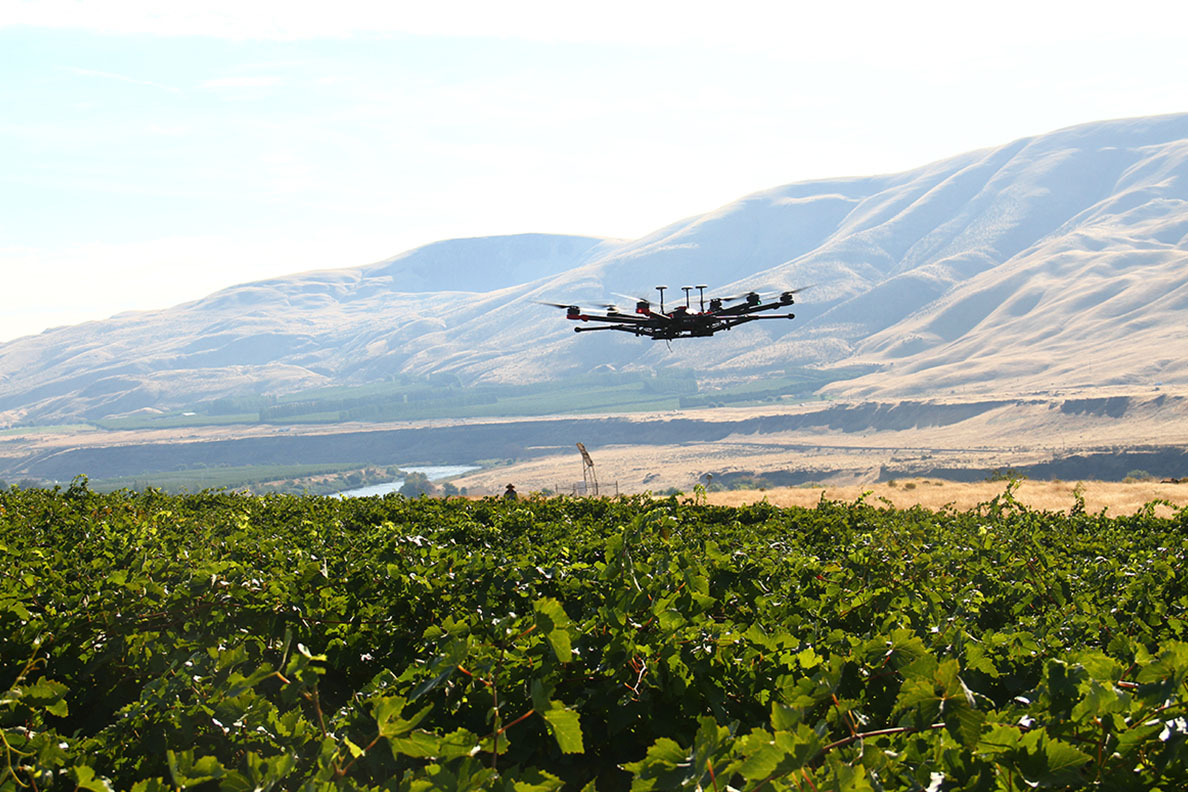
So, for instance, in a digital agriculture application, their more efficient software and hardware could be embedded on a UAV, which could efficiently make decisions about crop spraying with less computational and energy requirements.
Nitthilan Kanappan Jayakodi
The researchers have applied their algorithms to virtual/augmented reality as well as image editing applications. The researchers are the first to adapt state-of-the-art AI approaches for structured outputs to a mobile platform. These include Graph Convolution Networks (GCNs), which are used to produce three-dimensional object shapes from images in augmented and virtual reality, and Generative Adversarial Networks (GANs) technology, which is used to generate synthetic images. In the case of the GAN technology, the solution the researchers developed was able to achieve a more than 50% savings in energy for a loss of about 10% in accuracy.
“Since mobile platforms are constrained by resources, there is a great need for low-overhead solutions for these emerging GCNs and GANs to perform energy-constrained inference,” said Nitthilan Kanappan Jayakodi, a graduate student in the School of Electrical Engineering and Computer Science who was lead author on the research and was selected as a Richard Newton Young Fellow from the ACM Special Interest Group on Design Automation for his outstanding research contributions. “To the best of our knowledge, this is the first work on studying methods to deploy emerging GCNs and GANs to predict complex structured outputs on mobile platforms.”
The work was funded by the National Science Foundation and the U.S. Army Research Office.
November 06, 2020 at 09:00PM
https://ift.tt/2JGUiDG
Artificial intelligence on the edge | WSU Insider | Washington State University - WSU News
Strategic, narrative driven city-builder Per Aspera finally has a release date: December 3rd. We first saw Per Aspera at the 2019 PC Gaming show, and at the time we thought that it was both pretty and promising. Now, we can confirm, that it is in fact both pretty and promising. The game stars voice actor Laila Berzins as artificial intelligence AMI and Troy Baker as Nathan Foster, the doctor who built AMI and sent it out to terraform Mars.
Per Aspera is a city building game, but it's set on a real, to-scale map of Mars based on satellite images. The player is AMI, an artificial intelligence put in overall control of the terraforming and colonization efforts on Mars after decades of failed colonization attempts. THe game has been advertised as heavily narrative from the start, and from the looks of the trailer's end sequence the big twist is going to be bigger than you might expect: Mars' skies darken as thousands of mysterious spaceships descend.
We'll have more details on Per Aspera in the run up to its release. The game has been on Steam for a bit, but there's a free demo if you'd like to try it in the window before release. Per Aspera is developed by Tlön Industries and published by Raw Fury. It's planned to release December 3rd on Steam.
Image 1 of 9
(Image credit: Tlön Industries)
Image 2 of 9
(Image credit: Tlön Industries)
Image 3 of 9
(Image credit: Tlön Industries)
Image 4 of 9
(Image credit: Tlön Industries)
Image 5 of 9
(Image credit: Tlön Industries)
Image 6 of 9
(Image credit: Tlön Industries)
Image 7 of 9
(Image credit: Tlön Industries)
Image 8 of 9
(Image credit: Tlön Industries)
Image 9 of 9
(Image credit: Tlön Industries)
November 08, 2020 at 05:59AM
https://ift.tt/3llNJ7m
Be an AI and terraform Mars next month in Per Aspera - PC Gamer









/article-new/2021/06/iphone-13-duan-rui2.jpeg?lossy)


